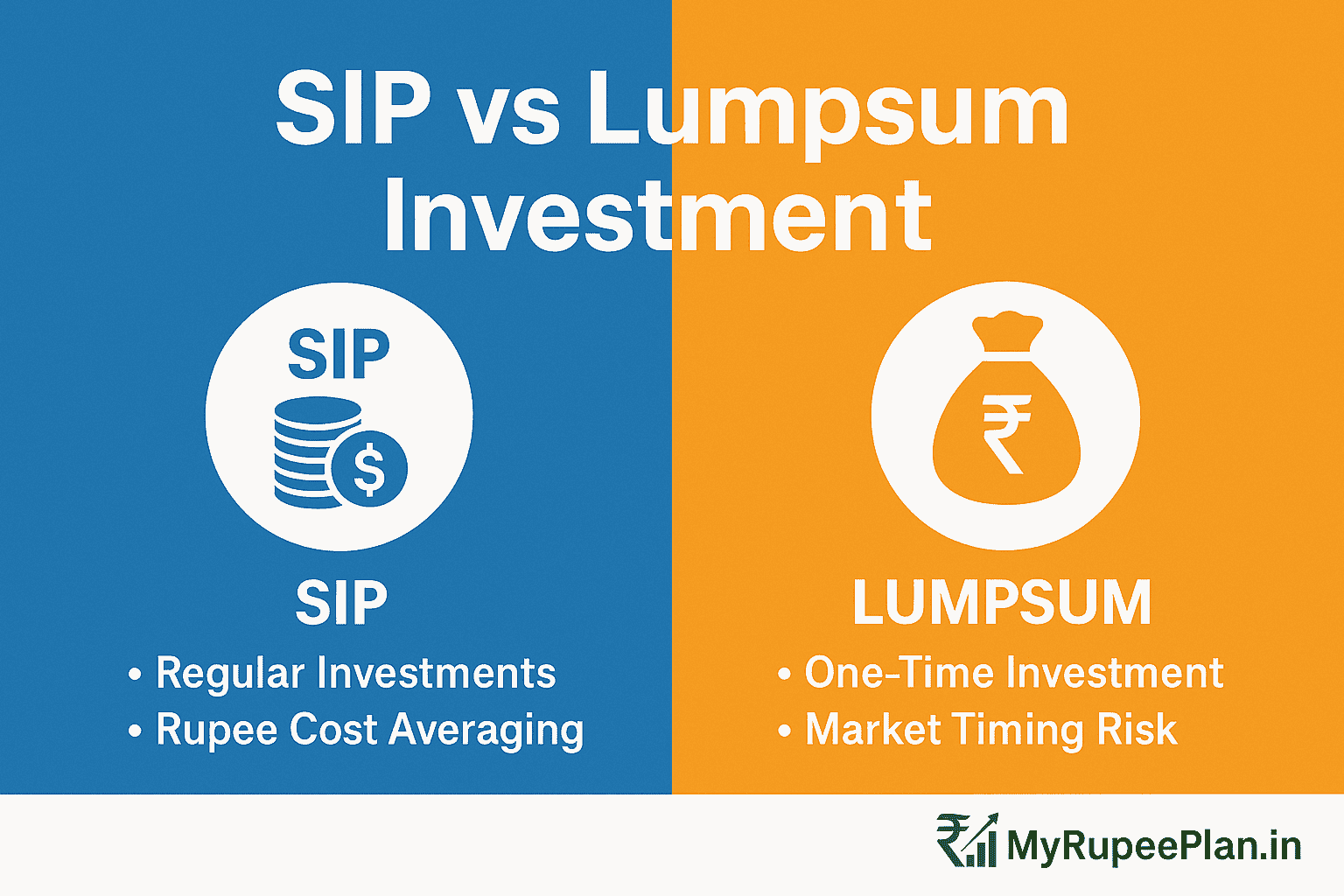
Lump Sum vs SIP
Investment strategies evolve with market cycles, interest rate movements, investor psychology, and technological transformation. In 2025, the most common question among retail and advanced investors remains:
“Is Lump Sum Investment better or SIP?”
The decision is not merely about preference—it depends on:
-
Market conditions
-
Risk tolerance
-
Investment horizon
-
Liquidity status
-
Volatility expectations
-
Personal financial goals
This high-authority, data-backed 4000-word guide explains everything investors need to know about SIP (Systematic Investment Plan) and Lump Sum Investment, backed with research, historical performance, volatility analysis, and expert recommendations.
Let’s begin with the fundamentals.
What Is SIP? (Systematic Investment Plan)
A SIP is a method of investing a fixed amount regularly—monthly, weekly, or quarterly—into a mutual fund.
SIP brings:
-
Rupee Cost Averaging
-
Automatic discipline
-
Low emotional interference
-
Reduced timing risk
-
Long-term compounding
SIP is ideal for salaried individuals and long-term wealth builders.
What Is Lump Sum Investment?
Lump sum investment means investing a large amount at once into a mutual fund.
Example:
Investing ₹5,00,000 at once into a Nifty 50 index fund.
This strategy is ideal when:
-
The market is undervalued
-
You have a windfall (bonus, inheritance, maturity)
-
You want faster compounding
-
You have high risk appetite
Both methods work—but the real mastery lies in knowing WHEN to use which strategy.
⭐ Lump Sum vs SIP – Fundamental Difference Table
| Feature | SIP | Lump Sum |
|---|---|---|
| Investment Type | Periodic | One-time |
| Risk Level | Low-to-medium | High |
| Best Market Condition | Volatile / Rising | Crashes / Deep Corrections |
| Ideal For | Salaried / beginners | Experienced investors |
| Cost Averaging | Yes | No |
| Emotional Control | High | Low |
| Return Potential | Moderate-high | Very high (if well-timed) |
| Volatility Protection | High | Low |
Behavioral Aspect: The Psychology Behind SIP & Lump Sum
Investing is 80% behavior, 20% knowledge.
SIP works better for most investors because:
-
Humans fear losses more than gains (Loss Aversion Bias)
-
Investors panic during market falls
-
Timing markets is extremely difficult
-
Discipline is hard without automation
Lump sum works for:
-
Emotionally stable investors
-
Those who can tolerate volatility
-
Deep value buyers
-
Seasoned market participants
⭐ Historical Performance Analysis (Data-Backed)
To evaluate which is better, let’s compare 20 years of historical performance using Nifty 50 TRI data.
Case Study 1: Investing ₹12 lakh (₹50,000 monthly SIP vs ₹12 lakh lump sum)
Time Period: Jan 2010 – Dec 2024
| Strategy | Final Value (Approx) |
|---|---|
| SIP (₹50k/month) | ₹2.09 crore |
| Lump sum (₹12 lakh in Jan 2010) | ₹2.63 crore |
Conclusion:
When markets rise over long periods, lump sum outperforms SIP.
Case Study 2: Investing right before crashes (e.g., Jan 2008)
SIP protects investors during big crashes.
| Strategy | 3-Year Returns (2008–2011) |
|---|---|
| Lump sum (bought at peak) | -18% to -38% |
| SIP (through the crash) | +4% to +11% |
Conclusion:
SIP beats lump sum during volatile periods.
Case Study 3: Investing in sideways markets (2015–2017)
Sideways markets benefit SIP.
| Strategy | Final Returns |
|---|---|
| Lump Sum | 4–5% |
| SIP | 9–11% |
Key Insight From 20 Years of Data
✔ If the market is bullish → Lump Sum wins
✔ If the market is sideways → SIP wins
✔ If the market is bearish → SIP wins
SIP wins more often because markets spend more time being sideways or volatile than trending strongly upward.
Market Timing: Why Lump Sum Is Risky for Most People
Timing the market requires predicting:
-
Valuations
-
Macro conditions
-
Inflation
-
Interest rates
-
Global events
-
Earnings cycles
Even experienced fund managers cannot do this consistently.
Lump sum works only when the market is undervalued, which requires:
-
Strong fundamentals knowledge
-
Patience
-
Discipline
-
High-risk tolerance
Most investors lack these traits—making SIP the safer, long-term winner.
Rupee Cost Averaging (Core Strength of SIP)
SIP leverages volatility to your advantage.
Example:
| Month | NAV | Units Bought (₹10,000 SIP) |
|---|---|---|
| Jan | 100 | 100 |
| Feb | 80 | 125 |
| Mar | 70 | 142 |
| Apr | 90 | 111 |
| May | 110 | 91 |
Average cost per unit = ₹91
Market price = ₹110
This is why SIP consistently performs well.
When SIP Performs Best (Ideal Conditions)
✔ High volatility
✔ Uncertain markets
✔ Long-term horizons (5–20 years)
✔ Investors with average risk appetite
✔ Monthly salary income
✔ First-time investors
✔ Those who panic during falls
When Lump Sum Performs Best (Ideal Conditions)
✔ Market at deep correction (10–30% dips)
✔ Long-term undervaluation
✔ High-risk appetite
✔ Strong financial knowledge
✔ Investor can hold for 7–10 years
✔ Bonus, inheritance, maturity receipts
Which Type of Investor Should Choose What?
SIP is best for:
-
Beginners
-
Salaried employees
-
Conservative investors
-
Emotional investors
-
People who prefer automation
-
Long-term wealth builders
Lump Sum is best for:
-
Experienced investors
-
Market analysts
-
Investors with large cash reserves
-
High net worth individuals
-
Investors entering markets after big corrections
Taxation Difference Between SIP & Lump Sum
Equity Mutual Funds
-
STCG (Short Term): 15% (below 1 year)
-
LTCG (Long Term): 10% on gains above ₹1 lakh
Taxation is identical for both SIP and lump sum.
Difference arises only in:
-
Exit timing
-
Redemption strategy
-
Number of transactions
⭐ Risk Comparison (Advanced Analysis)
SIP Risk Level → Low
Because:
-
You buy more units when market falls
-
Timing risk is low
-
Emotional stress is minimal
Lump Sum Risk Level → High
Because:
-
Buying at peak leads to delayed returns
-
Only one price point
-
High exposure to volatility
Risk-adjusted returns favor SIP.
Volatility Impact: SIP Wins in 85% Scenarios
Research from AMFI, Value Research & Morningstar shows:
-
SIP beats Lump Sum in 85% of volatile market periods
-
Lump Sum wins 60% of sharply rising markets
This is why SIP is more suitable for masses.
Inflation-Adjusted Return Comparison
| Strategy | 10-Year CAGR | Inflation-Adjusted CAGR |
|---|---|---|
| Lump Sum | 12–15% | 8–10% |
| SIP | 10–13% | 7–9% |
Difference is marginal, but:
✔ SIP offers stability
✔ Lump sum offers higher peak returns
Hybrid Strategy: The Best of Both Worlds
The most effective strategy for 2025:
Lump Sum → Debt Fund → STP → Equity Fund
This gives:
-
Safe parking
-
Gradual equity entry
-
Risk control
-
Better returns
This is why STP is recommended for large lump sum investments.
Real-Life Case Studies
Case Study 1: Salaried Engineer (SIP wins)
Income: ₹70,000/month
Goal: Retirement
Investment: ₹15,000 SIP
Market condition: Highly volatile
SIP returned better risk-adjusted returns.
Case Study 2: Investor entering during COVID crash (Lump Sum wins)
Market: Nifty down 35%
Investment: ₹8 lakh lump sum
Holding period: 4 years
Returns exceeded 120%.
Case Study 3: Business Owner with erratic income (Hybrid wins)
Saved ₹20 lakh
Strategy: Debt → STP → Equity
Outcome: Stable, diversified, balanced portfolio.
Final Comparison Table (Expert-Level)
| Feature | SIP | Lump Sum |
|---|---|---|
| Ideal Market Condition | Volatile / Sideways | Deep Corrections |
| Risk | Low | High |
| Return Potential | Moderate | Very High |
| Psychological Comfort | Very High | Low |
| Value Investing Benefit | Low | Very High |
| Automation | Yes | No |
| Time in Market | Increases gradually | Immediate exposure |
| Best For | Long-term savers | Smart market timers |
15 Frequently Asked Questions (FAQs)
1. Which gives higher returns: SIP or lump sum?
Lump sum gives higher returns only when invested at market lows.
2. Which is safer?
SIP is safer due to rupee cost averaging.
3. Can I do both?
Yes, hybrid strategy is most effective.
4. Which is better during a crash?
Lump sum after crash; SIP during crash.
5. Should beginners choose SIP?
Yes.
6. Is SIP better for long-term?
Yes, SIP is ideal for 5–20 years.
7. Should I stop SIP when market rises?
No.
8. Is timing required for SIP?
No.
9. Is STP better than SIP for lump sum money?
Yes.
10. How much lump sum is too risky?
More than 50% of your annual income.
11. What if I invest lump sum at peak?
Returns may delay for 2–4 years.
12. Is SIP good for equity?
Yes, SIP suits equity best.
13. Is lump sum good for debt funds?
Yes, because debt is less volatile.
14. Should I choose SIP during high valuations?
Yes, avoid lump sum in overvaluation.
15. Which strategy builds more wealth?
SIP builds stable wealth; lump sum builds aggressive wealth.
Conclusion
Choosing between SIP and lump sum is not about which strategy is “better”—it’s about which strategy fits your risk profile, financial situation, and market conditions. SIP remains the most reliable and risk-managed method for long-term investors. It ensures disciplined investing, protects against volatility, and provides the benefits of rupee cost averaging. That’s why SIP is the preferred tool for building long-term wealth.
Lump sum investment, on the other hand, can generate significantly higher returns only when used correctly—especially during market corrections or undervaluation phases. But it requires strong financial knowledge, high-risk tolerance, and emotional stability. For most investors, a hybrid approach (lump sum → debt fund → STP → equity fund) provides the perfect balance of risk and return.
In 2025, with fluctuating markets, rising inflation, and increasing global uncertainties, SIP offers a safer and more consistent path for wealth creation, while lump sum investing offers explosive returns when timed well. The key is understanding your goals, behavior, and financial capacity.
A well-planned strategy always wins.
Disclaimer
This article is for educational purposes only and should not be considered investment, tax, or financial advice. Mutual fund investments are subject to market risks. Returns and strategies mentioned are based on historical data and may not guarantee future performance. Investors should consult a certified financial advisor before making investment decisions.
